

TPU Film Manufacturing: Casting Process Innovations
- 2026-08-16
- EVA TPU Film Manufacturers & Suppliers in China
- 962
Ever wonder what's quietly working behind the scenes in phone cases, athletic shoe uppers, or even medical dressings? The answer is TPU film. This remarkable material—stretchy yet strong—is reshaping everyday products through precision manufacturing. Let's take a closer look at how TPU film is made, with a special focus on the innovations in cast film technology.
TPU film production starts with specially formulated resin pellets, which are melted and plasticized under tightly controlled temperature conditions. Modern extrusion technology pushes the material's potential to its limits, using the precise interplay of screw and barrel to transform solid pellets into a consistent melt. Temperature control here is almost an art form—get it wrong, and the final film's performance suffers.
Extrusion sits at the heart of TPU film manufacturing. As the raw material feeds from the hopper into the extruder, it undergoes three key transformations—compression, melting, and homogenization—driven by the rotating screw. The screw's specialized geometry is critical: it must withstand high pressure and heat while ensuring steady material flow. Professional extruders like those from JSW use advanced temperature control systems to keep melt temperature fluctuations within ±1°C.
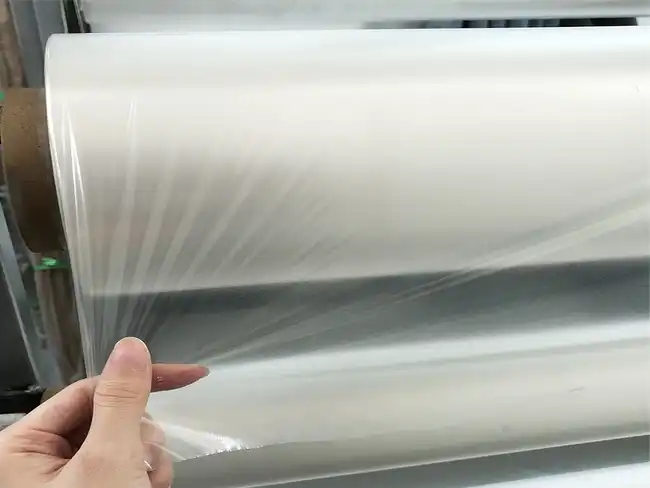
Cast film processing represents the technical peak of TPU film production. After the molten TPU is extruded through a slit die, it's immediately quenched on a chilled roller to set its shape. This seemingly simple step actually demands precise control over three variables: die lip gap determines film thickness, roller temperature affects surface finish, and take-off speed influences molecular orientation. Top-tier manufacturers hold thickness variation to within ±3%.
Compared to traditional blown film methods, cast TPU film offers more uniform thickness distribution and a smoother surface quality. That gives it a clear edge in high-end applications like medical dressings and protective films for electronics. Specialty TPU resins developed by major producers such as Wanhua have further improved tear resistance and weatherability in cast films.
Post-processing is just as important. From haul-off and slitting to winding, every step can affect the final product's performance. Modern production lines rely on automated control systems and can run at speeds up to 200 meters per minute. By fine-tuning the cooling roller temperature, manufacturers can achieve surface finishes ranging from matte to high gloss.
The success of cast TPU film also comes down to the material's design flexibility. By adjusting the ratio of polyester-based or polyether-based TPU, producers can tailor products from ultra-soft to highly elastic. This versatility opens up vast possibilities in bonded fabrics for apparel, automotive interiors, and beyond. Industry leaders are now developing specialty TPU films with added features like breathability and antimicrobial properties.
From raw material selection to finished roll, TPU film production is a finely orchestrated systems engineering process. As equipment technology and materials science continue to advance, future TPU films will get thinner, stronger, and more widely applicable. Whether in wearable devices or smart packaging, this endlessly adaptable material will keep surprising us.